

Table of Contents
- Introduction
- The Businesses That Will Win This Revolution
- Stage 1: Static AI
- Stage 2: Generative AI
- Stage 3: Agentic AI
- The Real Shift: Interface, Not Just Intelligence
- From Reactive to Proactive Organisations
- The Preconditions for Success
Introduction
The last year or so has witnessed the fastest adaption of a new technology in the history of IT.
With the introduction of Natural Language Processing (NLP) AI has changed the way many dissimilar tasks are done; all because it changes the way people interact with computers.
- Turn either written or audio notes/conversations/meetings into polished documents with focus points; summaries; action points; recommendations.
- Intelligent self learning
- Create images; music and limerics!
- Read images to identify it and then lookup online to retrieve suppliers and prices
- Document search (word, excel, email) including in analysis and summary.
- Codeless programming
- Task automation and data analytics
- Translate languages
In addition to general discussion; the following highlights how Ai is transforming the way Infoware Services work – both internally and within our applications. And this is only the beginning as AI uses continue to evolve.
With all these conveniences comes an important caveat: AI is not always correct. Language models generate the most statistically likely response, not a verified one, which means they can produce answers that are plausible, confident and wrong — inventing citations, misreading a figure in a spreadsheet, or filling a gap in a document with something that was never there. They can also carry forward errors or bias present in the material they were trained on, and they have no inherent sense of when a question falls outside what they actually know. This does not diminish the value of the technology; it simply defines how it should be used. AI is best treated as a very fast, very capable assistant whose work still passes across a human desk before it goes anywhere that matters. Checking source references, spot-testing figures, and keeping a person accountable for the final output are not obstacles to adoption — they are what makes adoption safe. The organisations that get the most from AI will be the ones that pair it with good judgement.
The Businesses That Will Win This Revolution
The winners won’t necessarily be the fastest adopters. They’ll be the businesses with the strongest foundations — the systems, processes and data that make new technology reliable, scalable and ready to work; such as:
- Data quality is not an IT problem — it is the limiting factor on every AI initiative. Organisations with fragmented, inconsistent data will see pilots stall repeatedly before reaching production.
- Governance must be designed, not bolted on — Access controls, audit trails, and business rule definitions need to exist before AI systems are connected to sensitive data.
- The human role evolves, not disappears — Three out of four enterprise leaders report positive returns on Gen AI investments, but 43% also note the risk of declining proficiency in skills that AI begins to substitute. Maintaining judgment alongside automation is the ongoing challenge. Wharton/GBK AI Adoption Report
- Start with the interface problem, not the intelligence problem — Most organisations already have the data to generate useful insights. The barrier is usually access, not absence. Natural language interfaces resolve that barrier without requiring new data infrastructure.
When OpenAI released ChatGPT, it reached one million users within five days and 100 million within two months — faster than any consumer platform in history, including TikTok, which took nine months to achieve the same milestone CBS News. The speed of adoption was not merely a product of novelty. It reflected something more fundamental: for the first time, ordinary people could interact with software in the same language they used to talk to each other. The interface adapted to the human, not the other way around.
That moment was significant not because it invented AI, but because it made AI visible. For decades, artificial intelligence had been running silently in the background of everyday life. The real question is what comes after that visibility — and what businesses need to do to capture its value.
There are 3 phases of AI:
Stage 1: Static AI
Long before ChatGPT, businesses were already depending on AI — they just didn’t call it that. The first scientific paper on neural networks was published in 1943, and by the 1960s, purpose-built AI systems were already operating in specific domains. What most organisations deployed in the decades that followed falls under a category now often called static AI: systems trained to perform a single, well-defined task with high consistency and at scale.
These systems are everywhere:
- Spam filters that continuously adapt to new techniques to separate legitimate email from junk
- Fraud detection engines that flag unusual card transactions in milliseconds
- Recommendation systems that drive purchasing decisions across retail and streaming platforms
- Rule-based automation that handles repetitive operational workflows without human involvement
The value of static AI is not creativity — it is reliability. These systems follow patterns, apply predefined logic, and produce predictable outcomes across millions of transactions. For most organisations, they form the backbone of operational efficiency. Each system is, however, fundamentally narrow. It solves one problem well and cannot be repurposed. Interacting with it typically means navigating a purpose-built interface, and interpreting its outputs still requires human judgment in context.
Infoware Services has been deploying Static AI since 2018 to automate document processing:
One example is customer order processing. AI reads emailed PDF purchase orders—regardless of layout or format—and converts them into a standard format importing them directly into Infoware. Once a customer’s document format has been mapped, data extraction is effectively 100% accurate, quick and eliminates manual data entry.
Where you have a number of different customers who generate their own orders and do not want to re-enter via Infoware’s e-commerce portal, and their volumes and IT skills do not warrant EDI; this is the missing piece of the jigsaw for Infoware to provide a data–entry free environment for customer orders.
The same static AI technology is also applied to supplier invoice processing. Supplier invoices received by email are automatically read, translated, and created in Infoware as unapproved invoices.
Infoware then performs a three-way match during the stock receipting process by comparing each invoice line against the original purchase order and the goods received. Where quantities and pricing all agree, the invoice is automatically approved for payment without any manual intervention.
For many customers, this eliminates more than 98%+ of manual supplier invoice processing. Your staff only need to review invoices where there are genuine exceptions, such as pricing discrepancies or differences between the quantities received, and invoiced.
The result is a faster, more efficient accounts, error free, payable process, with reduced administration, fewer processing errors, and staff who can focus on resolving exceptions rather than processing routine invoices.
See the impact of translating Supplier Invoice pdfs (as a form of static AI) into unapproved supplier invoices automatically allow change to the work environment at Photocreate.
Static AI remains essential infrastructure. It does not compete with what comes next — it coexists with it.
Stage 2: Generative AI
Generative AI introduced something qualitatively different from its predecessors: flexibility across domains. Rather than being locked to a single task, generative models can produce new content — text, images, code, structured data — across an open-ended range of inputs. This is what powers tools like ChatGPT, and it is why their adoption curve looks unlike anything in the prior history of enterprise software.
The business impact has been immediate and measurable. McKinsey estimates that generative AI could add as much as $4.4 trillion annually to the global economy, with the largest gains concentrated in marketing and sales, customer operations, software engineering, and R&D. Enterprise adoption reflects this potential. Within months of ChatGPT Enterprise’s launch in August 2023, more than 80% of the Fortune 500 had begun using OpenAI tools; by mid-2025, that figure climbed to 92%.
For day-to-day business operations, the practical applications are wide-ranging:
- Drafting communications, summaries, and reports in a fraction of the prior time
- Generating first drafts of code, then refining with developer oversight
- Translating, reformatting, or restructuring documents across systems
- Brainstorming options and pressure-testing strategies
What makes this powerful is not just speed — it is accessibility. A non-technical staff member no longer needs to know how to structure a query in a BI tool or i4 query to navigate an ERP data hierarchy to get useful output.
What Generative AI Is Not
It is important to be precise about the limits of generative AI, particularly in business contexts where accuracy matters. These systems are pattern-completion engines, not knowledge databases. They generate statistically likely outputs based on training data and context — which means they can produce confident, fluent, and entirely incorrect answers. IT being IT rather than call this an error calls this AI hallucination! As of 2025, 71% of organisations reported that they cannot fully trust autonomous AI agents for enterprise use, and over 75% of consumers express concern about misinformation from AI.
In practice, this shifts the human role from creator to editor and decision-maker. Think of it as an intelligent assistant that produces a high-quality first draft in seconds, allowing people to spend more time reviewing, refining and making decisions. This is not a limitation to work around — it is the appropriate division of labour given where the technology currently sits.
A Practical Example
One example is the workflow diagram shown in our article on supplier price management. The diagram was generated from the page content using ChatGPT in just a few seconds before being refined into its final version
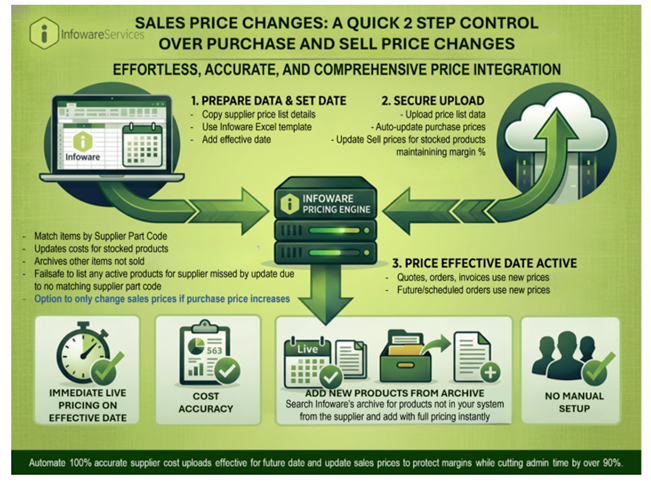
AI dramatically reduced the time required to create the initial design plus did a superb job while allowing our team to focus on improving the final presentation. Note ChatGPT no longer appears to do this in the free version.
Otter.ai
Otter.ai is an AI-powered assistant that records audio, writes real-time transcriptions, and generates automated meeting summaries. It works by capturing speech through a device microphone or virtual meeting bot, processing the audio via speech recognition and natural language processing, and organizing the output into searchable, shareable notes with tagged speakers and action items.
We use otter ai for all sales calls. This reduces time to produce presentations by 80% (converting spoken conversation into summaries; action points etc) ) and adds about 30%. (I need to look for/remove “hallucinatory” statements.)
This integrates with calendars to automatically record all planned meetings (outlook calendar and teams meeting in our environment).
As with any generative AI tool, transcripts and summaries must still be reviewed closely for accuracy, particularly around technical terminology or sensitive commercial detail, before being relied on for formal business decisions.
For That Those Require a More in Depth Explanation on otter ai
Otter.ai is an AI-powered meeting assistant that automatically records voice, transcribes, and summarises spoken conversations in real time. Rather than requiring someone to take manual notes, Otter joins virtual meetings (via Zoom, Microsoft Teams or Google Meet) and listens to in-person conversations through a phone or laptop microphone, converting speech into a live, searchable transcript as the conversation happens. Under the hood, Otter combines several layers of AI technology. First, an automatic speech recognition (ASR) engine converts raw audio waveforms into text, using deep learning models trained on vast amounts of spoken language to handle different accents, background noise and speaking styles. Layered on top of this is speaker diarisation, a technique that analyses the unique acoustic characteristics of each voice to work out who is speaking and when, so the transcript can correctly attribute each line to the right person. Once the raw transcript exists, a natural language processing (NLP) layer cleans it up — adding punctuation, correcting grammar, and applying custom vocabulary the user has taught it (technical terms, product names, industry jargon) to improve accuracy over time.
For those of us who used audio conversion to text tools such as Dragon Naturally Speaking in the past this is a dream not thought possible.
Finally, a large language model (LLM) is applied on top of the finished transcript to generate automatic summaries, extract action items, and answer follow-up questions about what was discussed, similar in principle to how ChatGPT or Claude generate text but scoped specifically to the content of that meeting. The benefits for a business are significant: staff spend less time manually note-taking and can stay fully engaged in the conversation itself; meetings become a searchable, permanent business record (including transcript) rather than a memory-dependent one; action items and decisions are captured and can be shared automatically with people who weren’t present; and information becomes more accessible to team members who are deaf, hard of hearing, or working asynchronously across time zones. As with any generative AI tool, transcripts and summaries should still be reviewed for accuracy, particularly around technical terminology or sensitive commercial detail, before being relied on for formal business decisions.
Accelerating Software Development ~ Codeless programming
Generative AI is also changing how software is created.
Traditionally, developing a new more complicated application involved numerous workshops, design revisions and discussions before agreeing on user interfaces, forms and business rules.
Today, AI allows much of this work to be completed before any programming begins and importantly, developed by non IT staff who have a better knowledge of the specific work environment.
For a new Infoware services client they used Claude AI to help create:
- User interfaces
- Screen layouts
- Business workflows
- Validation rules
This project has translated from using AI (Claude) to show required application interface; business rules to ‘this actually works. Plus I can keep refining it for improving on what I can currently do’.
Remember this is all in the natural language interface (NLP) issuing instructions by the client.
This process follows several iterations of get result/change for corrected answer until you end up with expected behaviour. As with all implementations you need to test and retest results with a variety of conditions ensuring you get the right / expected results (referred to as training IA for YOUR required needs).
So where does Infoware fit into this?
A core problem is that there are 7 different programs that client uses as business has evolved before this project – and stock control is not automated or accurate (both in a qty and margin sense) in any of them. So Infoware amongst other things will integrate with the Claude AI app SOP’s to record stock usage and replenishment across multiple service vans and perform purchasing; stock receipting and control in both main warehouse and each van. Additionally margin per product; job; day etc is visible in Infoware.
As AI continues to evolve, these “codeless development” capabilities of combining operations; logistics; stock control and financials single solution will become an increasingly mandatory and critical part of business ERP projects. Infoware is currently evolving load planning and route optimisation via AI as an example.
Stage 3: Agentic AI
Agentic AI is ‘the next level’ and continues to evolve. Agentic AI moves beyond generating responses and begins to execute structured workflows within defined boundaries. Rather than answering a question, agentic AI can:
- Retrieve and combine data from multiple sources
- Apply business rules and conditional logic across that data
- Execute multi-step workflows and trigger actions in connected systems
- Monitor conditions over time and respond to changes without being prompted
The distinction is significant: instead of asking “What is the answer?”, you are asking “Can you take care of this?”
Rather than acting like an intelligent search engine, Agentic AI behaves more like a capable digital assistant that can analyse, decide and act within defined business rules.
What Agentic AI Looks Like in Practice for a Business
The use cases include:
- “Send me a list of products with less than 2 weeks SOH at 8:00 each Tuesday.” — this is generated as such – you can ‘train’ AI as to whether this is per branch or all branches; how you calculate weeks SOH (or using Infoware KPI).
- Plus your query could be more granular: Each Tuesday at 8:00 list me chemical products less than 2 weeks SOH; accessories less than 4 weeks SOH; paper less than 6 weeks and the remain products 5 weeks. Ignore equipment lines.
- “Identify customers with overdue accounts and send follow-up reminders” — the system queries accounts, filters by account status, drafts personalised messages, and schedules dispatch
- “Monitor sales trends and alert me if a key product drops more than 15% week-on-week” — continuous monitoring with automatic escalation, no manual report required
- “Prepare a weekly performance summary and distribute it to the management team” — structured data synthesis, formatting, and distribution on a defined schedule
Example 1: From Manual Reporting to Plain Language Queries ~ Claude AI
A recent project was integrating Claude in EzFurn’s Infoware environment illustrates how these principles operate in a real business context.
Previously, answering a moderately complex analytical question — such as identifying products with significant sales shifts — required a multi-step manual process:
create i4 query then i4 plugin; build pivot tables, and interpret the results. This is not unusual. In most businesses, accessing insights still requires a combination of system knowledge, manual data handling, and time.
The experience changes from “build a report and analyse it” to simply “ask a business question and receive an informed answer.”
The Approach ~ Why We Refresh Data Daily
Rather than allowing AI to query live production databases, infoware refreshes AI reporting datasets automatically each night (or periodically as required).
This approach provides several important benefits and controls:
- Predictable server performance with no uncontrolled AI queries or attacks
- Reduced cybersecurity exposure by limiting direct AI access to internal production systems
- A consistent, trusted snapshot of business data for reporting and analysis in a synchronised “at rest” state.
- Strong governance over which tables and fields AI is permitted to access
Most business analysis is based on information up to the close of business the previous day, making this approach both practical and secure.
Importantly, Infoware remains the organisation’s core single source of truth, controlling stock; payroll and other resource types. AI provides a smarter, simpler and more intuitive way to access and interpret business information. In other applications the timing of the data exchange maybe different to daily.
The new approach replaces that sequence with plain language queries against a structured daily data extract. A user can now ask literally:
“List all products whose average sales (by quantity) have moved more than 20% up or down over the last 6 months compared to the previous 12 months, excluding service products.”
| Design Choice | Why It Matters |
| Daily data snapshot (not live queries) | Keeps core system performance stable; prevents live calls that overwhelm the software |
| Business rules embedded in query logic | Ensures exclusions (e.g., service products) are applied consistently |
| Structured outputs: tables, charts, explanations | Returns actionable information, not raw data |
Several architectural decisions were made to optimise usability:
The result is not just faster reporting. It is a fundamentally different relationship between staff and data. The question changes from “How do I run this report?” to “What do I need to know?”
To view case study for EZFurn; Claude and Infoware visit.
The Real Shift: Interface, Not Just Intelligence
The most consequential change AI brings to business is not a capability leap — it is an interface revolution. This is a transition without historical precedent.
For the web’s first two years after its invention in 1991, it remained a text-only, command-line experience — complex enough that only technical users engaged with it. When Mosaic launched in 1993 as the first widely available graphical browser, making it possible to click rather than type commands, the web exploded. The underlying content had not changed. What changed was who could access it. The same dynamic played out again when mobile interfaces brought the internet to people who had never owned a desktop computer.
Conversational AI is the next layer of that progression. In the same way GUI browsers didn’t replace the underlying web infrastructure but dramatically expanded who could use it, natural language interfaces don’t replace existing business systems — they create a new access layer on top of them.
This shift has three structural implications:
1. Data becomes more usable. When access is simple, usage increases. Staff who previously relied on analysts or IT to extract insights can now query data directly — leading to broader organisational engagement with information that was always available but practically inaccessible.
2. Time shifts from preparation to interpretation. Less effort is spent on extraction, formatting, and cleaning. More time goes toward understanding what the data means, discussing implications, and making decisions. As the LLM-ERP research notes, reducing cognitive workload on the access process frees mental capacity for the analytical work that actually creates value.
3. The role of IT and data teams evolves. Rather than building and maintaining a library of static reports, the focus shifts to data quality and structure, access governance, business rule definition, and system reliability. This is a higher-value role — closer to infrastructure engineering than report generation.
From Reactive to Proactive Organisations
As these systems mature, the organisational impact extends beyond efficiency. Businesses move from reactive operations — running reports after the fact, noticing problems after they have grown — to proactive ones, where AI continuously monitors conditions and surfaces anomalies before they escalate.
Practical examples already operating at scale include:
- Flagging a sudden drop in sales for a key product, triggering investigation before the quarter closes. Rather than reactively asking for this in weekly/monthly reporting then you can ask to ‘let me know when sales of a product or customer drop by x %’. You now prompt once period of time to measure drop. That’s it.
- Identifying unusual purchasing patterns that indicate either opportunity or risk
- Highlighting potential stock shortages days before they would become visible through normal reporting cycles
This is where agentic AI delivers its highest-order value: not time savings on individual tasks, but an improvement in the organisation’s overall awareness and responsiveness to its own data.
The Preconditions for Success
Agentic AI is only as effective as the environment it operates in. The research evidence on this point is unambiguous and consistent across multiple studies: the largest gap between AI pilots and production deployments is not model capability — it is data foundation.
The five data fundamentals that determine whether agentic AI can move from proof-of-concept to reliable operation are:
- Unified, discoverable data — A metadata-rich catalog that allows systems to find and trust what they need
- Consistent master data — Core records (customers, products, suppliers) defined the same way across the organisation
- Automated lineage and quality monitoring — Every AI decision traceable back to its source
- Policy-driven access governance — Sensitive fields protected; access enforced by role, not trust
- Collaborative culture between AI and data teams — Technical and business stakeholders aligned on what data means and how it should be used
The governance gap is real and consequential. Only 6% of organisations have implemented an advanced security framework for AI. 44% lack robust systems to move data effectively; 41% struggle with inaccurate and inconsistent data. When agentic systems operate on poor-quality data, they do not fail slowly and visibly — they act confidently on wrong inputs, potentially at scale.
This is why the Infoware implementation example with EzFurn described earlier made a specific architectural choice: using a controlled daily extract rather than live system queries. That design decision is not a limitation — it is a governance feature. It ensures consistency, stability, and auditability, which are the preconditions for trusting the outputs that emerge.
AI is not just another feature to add to existing systems. It is becoming the primary way people will interact with them. The organisations that build the right foundation today will find that the technology amplifies what they already know — delivering faster decisions, broader access to insight, and a fundamentally more responsive relationship with their own data.
In case you missed link to view case study for EZFurn; claude and infoware here it is again.
Want to book in a demo?
Contact us:
 Photo Create: Turning Supplier Invoice Processing into an Automated Exception Workflow