


EZFurn is Australia’s premier importer and wholesaler of commercial furniture, serving hospitality, gaming, corporate, and outdoor developments nationally. Established in 2009, EZFurn manages the full furniture supply chain in-house — from sourcing and manufacturing relationships through to shipping, custom upholstery, powder coating, assembly, and freight management.
EZFurn has been an Infoware client since June 2017.
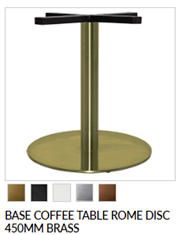
As an aside, EZFurn is the first site Infoware introduced the on hover palette technique where users can hover on a parent product’s palette for a product with different colors/finishes and the image dynamically changes allowing you to select any of the colours (products). This technique allows many more products on a page vs 1 product with all of its colour variants often taking up one page.
The Opportunity
EZFurn had been looking for ways to get more insight and analysis out of the data captured in Infoware. The data itself is clean and complete — but analysing large data sets natively inside the i4 plugins isn’t always easy.
They wanted to be able to simply ask questions like: “Which 10 products were most ordered last week?” or “Which customers have gone quiet in the last 4 weeks?” — and get an answer, not a report they’d have to build themselves.
The Infoware / Claude Solution
Infoware has provided the gateway for EZFurn to use Claude and Claude Code to access and organise the Infoware data, then using AI to analyse trends and patterns within it.
First, Infoware’s long standing i4 plugin technology allows you to define and extract data into Supabase, a PostgreSQL database. These extracts are scheduled to run daily at close of business, importing daily transactions, products, customers, and suppliers directly into Supabase. Once the data is there, Claude connects to it using its Model Context Protocol (MCP) connector — letting Claude read EZFurn’s data directly and securely.
The above process uses 3 different tools:
- Supabase
- MCP Connector
- Claude
Each is about $20.00 per month (total $60.00) so very cost effective in any language.
Because Infoware is a single-platform solution, it’s already AI-ready by design. It’s the client’s decision which modules to extract and expose for analysis — inventory, job costing, accounting, financials, payroll — individually or all together. This is a real advantage: many businesses run several disconnected internal systems with poor or inconsistent integration between them, which immediately becomes a problem for AI, since the data itself isn’t consistent across disparate systems.
This same MCP connector approach isn’t limited to Supabase. Claude can be connected to other data sources a business already has — separate databases, email inboxes, Excel spreadsheets — so the analysis isn’t boxed into a single system. For a business like EZFurn, that means Infoware data can sit alongside other information sources as needed.
The Outcome
EZFurn is in the early stages of this approach, but two strong use cases have already emerged.
The first is Claude Desktop connected directly to EZFurn’s Supabase data, letting the team query it in plain conversation — “Which 10 products were most ordered last week?”, “Which customers have gone quiet in the last 4 weeks?”, “What type of upholstered chair has been our most popular over the last 6 months?” Once Claude returns the data, the team can go back and forth with it — “Should we be looking at 6 months or 18 months of data here?”, “What other patterns do you see in customer ordering behaviour?” — turning a simple data pull into a genuine analysis session, rather than a static report.
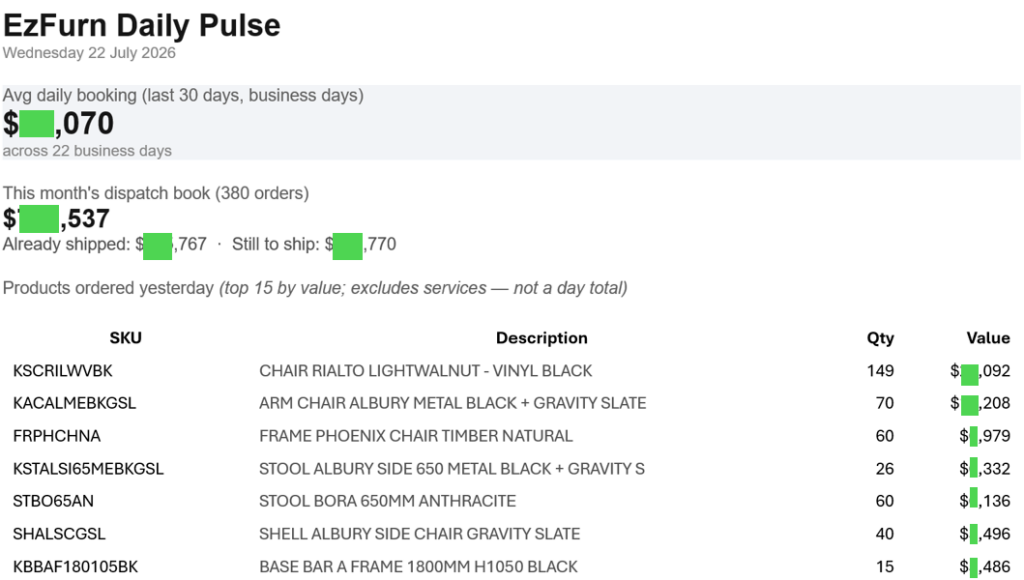
The second is a daily email. The team calls this the EZFurn Daily Pulse. Overnight, data is pulled into Supabase, and a script runs each morning at 7am to summarise it for the team — keeping everyone aligned on key metrics including average daily orders over the last 30 days, expected dollar value to ship this month, the top 10 products ordered yesterday, and the top 10 orders dispatched yesterday.
Looking ahead, EZFurn and Infoware are extending the same approach into demand and stock analytics — using the data to get ahead of reorder decisions, rather than just reporting on what’s already happened. It’s early days, but the model has proven flexible enough that it’s shaping up as a repeatable approach EZFurn can keep building on.
Infoware believes most of its clients will benefit from linking their data with Claude for deeper analysis. EzFurn are also happy to share what they’ve learned so far with any other Infoware business interested in exploring AI .
Critically this is available for clients that still run some applications in Infoware’s native interface.
Why this matters for other Infoware businesses
If you’re already running Infoware, your data is clean, structured, and ready to connect. Linking it to Claude can turn day-to-day reporting into genuine analysis — without needing a separate BI project or a data team to build it.
Interested in exploring this for your business?
Get in touch with Infoware Services to find out how.
 AI in Business: From Background Automation to Intelligent Decision-Making