

“We removed the supplier invoice bottleneck. What used to require constant checking and approval of supplier invoices is now reduced to genuine exceptions — with built-in controls that give us confidence in the accuracy of every payment.”
Tony Armstrong, Procurement Manager, Photo Create
About Photo Create
Photo Create is a Glen Innes, NSW-based, personalised,on-demand manufacturing and fulfilment business and a subsidiary of the Eastmon Group.
Established in 2006, Photo Create has evolved from the traditional photographic processing industry into a highly automated manufacturing and fulfilment operation. Today, the business specialises in manufacturing personalised photographic products, and shipping directly to customers on behalf of major retailers and international brands.
“We service clients like Officeworks, Big W, Harvey Norman and several international brands from Europe and the USA that require us to manufacture for their customer base in Australia,” says Hugh Eastwood, Managing Director of Eastmon Group, which operates Photo Create
Its current operations include two specialised production factories in Glen Innes — a Digital Print & Bindery facility and a Gifting facility — supported by dedicated warehouse, storage and dispatch operations. The business has retained its Glen Innes manufacturing base while building sophisticated digital, lean manufacturing and fulfilment capabilities that allow it to compete and ship anywhere in the world.
A manufacturing operation built around lean principles
Photo Create manufactures a broad and constantly changing range of personalised products, including:
- Print and bindery: softcover and hardcover photobooks, calendars, cards and digital prints.
- Personalised gifting: canvas and glass prints, wall décor, embroidered products, laser-engraved goods and name labels.
- Fulfilment: automated print-on-demand manufacturing and direct-to-customer fulfilment for retailers and international brands.
The business operates with around 100 full-time employees and can employ more than 300 casual staff during peak periods.
The seasonal nature of the business creates a significant operational challenge. Around 50–60% of annual production occurs during the six weeks leading into Christmas. Consequently, inventory availability, purchasing accuracy and manufacturing efficiency are critical.
Inventory replenishment was already highly automated
Photo Create had already implemented smart inventory replenishment processes within Infoware.
Rather than relying on traditional minimum/maximum stock levels, selected cartons carry Kanban cards. When these cartons are transferred into production, the Kanban card is scanned in Infoware.
The scan triggers the replenishment process, including the recommended economic reorder quantity and supplier lead time.
For local Aus suppliers, purchase orders are automatically generated and sent each morning at 9:00am, allowing suppliers to pick and ship orders the same day.
Overseas purchasing is managed differently because lead times can be around five months. Forecasts are uploaded into Infoware and alerts compare actual moving daily usage against weighted forecasts, highlighting projected weeks of stock cover and incoming shipments.
The purchasing and inventory process therefore already operated as a highly controlled lean manufacturing environment.
The problem was that supplier invoices processing and approval had not yet reached the same level of automation.
The bottleneck: supplier invoice approval
Photo Create purchases stock from more than 200+ suppliers, covering a wide variety of products and purchasing arrangements.
While purchase orders are created for all purchases, there was a significant administrative burden associated with checking supplier invoices.
Every stock receipt and supplier invoice required someone to verify:
- Is the supplier charging the correct price?
- Is the quantity invoiced the quantity received?
- Is the price still current?
- Is the invoice consistent with the purchase order?
- Has a supplier accidentally duplicated a charge (material or service)?
- Has a supplier invoiced more product than was ordered or received?
For a business operating a lean, just-in-time manufacturing environment, manually checking every invoice was becoming an unnecessary bottleneck.
The team needed a faster way to receive stock, update inventory and approve supplier invoices — without sacrificing financial controls.
The Infoware solution
The solution consisted of two complementary changes
1. Supplier price lists became the source of truth
The first requirement was ensuring that supplier pricing held in Infoware was always accurate.
Photo Create made supplier pricelist uploads a mandatory process.
Using Infoware’s existing supplier price-list template, each supplier’s current price list update the active products via supplier part-code prices.
This does more than support invoice approval. Accurate supplier pricing also provides a reliable basis for projected kit/BOM costing of products and helps the business determine appropriate selling prices.
More information: Staying Ahead of Supplier Price Changes with Infoware
2. Supplier invoices are created automatically before stock arrives
The second part of the solution is to eliminate the manual entry of supplier invoices.
Suppliers email PDF invoices to a predefined Photo Create email address.
Infoware automatically translates the invoice and creates it as an unapproved supplier invoice — before the physical goods arrive.
There is no manual data entry.
Having the unapproved invoice created in advance of stock arriving with zero human touches is the game changer.
When the stock arrives, the receiving team records the actual quantity received against the purchase order and unapproved invoice.
Infoware then performs a three-way match between:
- The original purchase order.
- The supplier invoice.
- The goods actually received.
Where price and quantity agree, the invoice is automatically approved for payment.
Where there is a discrepancy, the invoice becomes an exception requiring review.
This fundamentally changes the role of the procurement team.
Instead of checking every invoice, procurement only needs to investigate the exceptions.
From checking everything to managing exceptions
The biggest change for Photo Create is not simply that invoices are processed faster.
It is that the process has become a controlled exception workflow.
Most invoices flow through without manual intervention.
The procurement team focuses its attention on situations where something genuinely requires human judgement — such as:
- A supplier has charged the wrong price.
- The quantity invoiced differs from the quantity received.
- An invoice contains a duplicate charge.
- A supplier has oversupplied against the purchase order.
- A supplier has applied an unexpected freight charge.
This gives Photo Create the best of both worlds:
Automation for transactions that are correct.
Human intervention where judgement is required.
Supplier errors are caught
Infoware’s process has also exposed a range of supplier invoice errors that previously required manual checking to identify.
Examples include:
Duplicate charging of part deliveries
A supplier may invoice the first part of a delivery and then accidentally include the original delivery again when invoicing the final part.
The matching process identifies the discrepancy rather than allowing the duplicate amount to flow through unnoticed.
Duplicate invoice charges
The same purchase order can occasionally be invoiced twice, sometimes even under a different invoice number.
The controls provide an additional barrier against duplicate payment.
Oversupply
If a supplier delivers more product than was ordered, the discrepancy is highlighted for approval.
Where appropriate, an invoice adjustment can be sent immediately rather than subsequently waiting for a credit from supplier that may never arrive.
Part deliveries
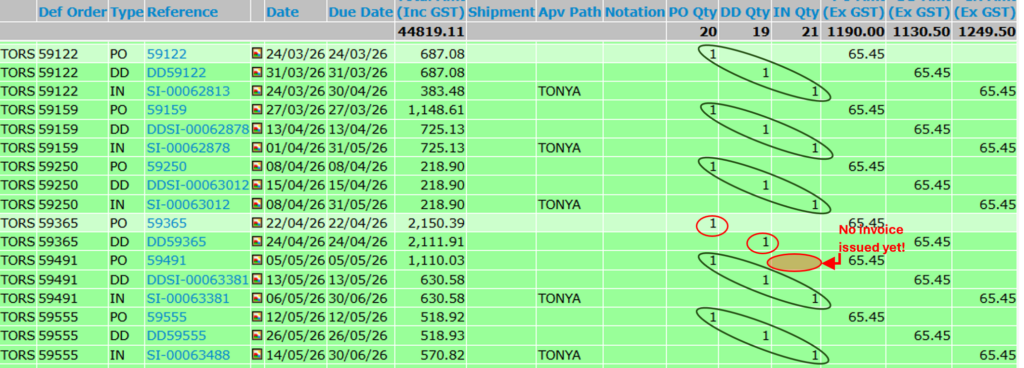
Infoware provides visibility across the purchase order, receipts and invoices, making it easier to establish exactly what has been ordered, received and invoiced.
For procurement staff dealing with suppliers over disputed quantities, this history is particularly valuable. This can be at a supplier level; purchase order with matching receipts and invoices level; or at times one product at a supplier or purchase order level to highlight discrepancies. Example following highlights for 1 product that an invoice not yet received for PO 59365.
Built-in controls without unnecessary administration
A key advantage for Photo Create is that the workflow can be configured according to the commercial requirement of each supplier.
Not every supplier operates in the same way — and Infoware does not require every supplier invoice approval to follow an identical matching process.
Examples include:
- Freight thresholds: Freight below a defined threshold are automatically approved.
- Variable cut-to-size products: Certain suppliers can be configured to allow invoiced/received quantities above the original PO quantity where the variation is an accepted consequence of cutting variable roll lengths, while continuing to check unit pricing.
- Cyclical supplier replenishment: One supplier monitors stock levels via infoware portal and replenishes according to agreed stock levels without a conventional PO. The supplier is flagged as not requiring a PO match while unit-price controls remain active.
- Consolidated timber invoices: Where a timber supplier invoices multiple lines for each sling of the same product, Infoware’s PDF translation process consolidates these lines into a single product-code line for easier and visual reconciliation.
- Urgent spare parts: Some overseas spare parts have variable landed costs and need to be purchased immediately to prevent a production line from stopping. Selected suppliers can therefore be configured to allow automatic invoice approval even where the unit price differs, while the overall spend remains subject to actual-versus-budget review.
This flexibility is important.
The objective is not to automate everything blindly. The objective is to automate what can be controlled and escalate what genuinely requires human judgement.
The outcome
What was once an administrative burden has become another efficiency cog in Photo Create’s lean manufacturing process.
Faster stock processing
Stock can be receipted and inventory updated immediately without waiting for an invoice to be manually checked and approved.
Greater payment accuracy
Supplier invoices are checked against the purchase order and actual goods received, providing confidence that Photo Create is paying for what it ordered and received.
Immediate invoice adjustments
Where received quantities are lower than invoiced quantities, the discrepancy can be identified immediately and an invoice adjustment created rather than relying on a future supplier credit which may never be sent.
Controlled workflow
Store staff focus on accurately recording what was received.
Procurement management only needs to become involved when an exception requires investigation or approval.
Full auditability
The supplier invoice document is retained and linked to the invoice lines and creditor account, providing a clear audit trail and making it easy to review the original supplier document for full visibility.
Better visibility
Unapproved invoices provide visibility that goods have been shipped and are on their way to help planning with the production pipeline.
Fewer manual approvals
Instead of procurement staff spending time checking invoices that are correct, their time is concentrated on the small number of invoices where something is genuinely wrong or requires a commercial decision.
Prompt-payment opportunities
Because invoices move through the workflow quickly, suppliers offering prompt-payment discounts are processed within the required timeframe.
A better fit for lean manufacturing
Photo Create’s experience demonstrates an important principle of process automation.
The goal isn’t simply to remove people from a process. It is to remove people from the parts of the process where they add little value — while directing their attention to the exceptions where their experience and judgement matter.
Photo Create had already automated inventory replenishment through Kanban, forecasting and supplier scheduling.
The supplier invoice workflow now follows the same philosophy.
Correct transactions flow automatically.
Exceptions are identified.
Controls remain in place.
And procurement staff spend their time resolving the issues that actually matter.
As Tony Armstrong, Procurement Manager at Photo Create, puts it:
“We removed the supplier invoice bottleneck to genuine exceptions to approve— critically, with built-in controls for accuracy and removing the potential for errors.”
For a highly seasonal, high-volume manufacturer where the majority of production occurs in a six-week Christmas peak, that difference is significant.
It is not just an accounts payable improvement.
It is lean manufacturing extended all the way from quicker stock receipts/stock level updates through to supplier payment.
 AI in Business: From Background Automation to Intelligent Decision-Making